Your app says the meal was 412 calories. Not "around 400" — 412. That precision is comforting, and it is entirely fictional.
Every calorie figure you have ever seen is an estimate, usually with a wider margin than anyone admits. This is worth understanding properly, because people who discover it accidentally tend to draw exactly the wrong conclusion — that tracking is pointless — when the real conclusion is much more useful.
Where the uncertainty comes from
It stacks up at every stage between the field and your log.
- Labels are allowed to be wrong. Nutrition labels carry legal tolerances, and the permitted margin is wider than most people assume — and, for calories, it runs in the unhelpful direction. Under US rules a product labelled 200 calories is still compliant at 240, because what the regulation caps is how far the real figure may sit above the label. The number on the box is a regulated approximation, not a measurement of the thing in your hand.
- Databases contradict each other. Search any common food and you'll find a dozen entries with different numbers, many submitted by users, some plainly wrong. "Chicken breast" is not one value; it's a spread.
- Portions vary enormously. A medium apple, a bowl of rice, a restaurant serving — all are ranges pretending to be quantities. Restaurant portions in particular vary hugely between branches of the same chain.
- Cooking changes things. How much oil the pan absorbed, how much fat rendered out and got poured away, how much you tasted while cooking. Oil is the biggest single source of quiet error in home cooking, because a generous pour is several hundred calories and looks like nothing.
- Photo estimates lean low. When AI estimates are tested against meals of known composition, they tend to underestimate — and the error isn't random. It gets worse the bigger the portion, so the meals most worth getting right are the ones it misses by most. A picture also can't see the butter in the sauce.
- Your own body varies. Absorption differs between foods and between people, and what you burn changes day to day with sleep, movement and stress.
Stack those up and any single meal figure could reasonably be out by a meaningful margin. Which sounds like it should be fatal to the entire enterprise.
Why it isn't a disaster
It isn't, because you don't need the true number. You need a consistent one.
Think about what the number is actually for. You're not conducting a laboratory assay of your dinner; you're trying to answer one question: should I eat a bit more, a bit less, or the same? For that question, a figure that's reliably 15% low is nearly as useful as a perfect one — because when you compare this fortnight to the last, the error is on both sides of the comparison and largely cancels out.
Your logged calories are best understood as a dial, not a measurement. What matters isn't the absolute reading, it's what happens when you turn it. If your weight trend is flat at "2,000", then 2,000 is your maintenance as you log it, whatever the true figure is. Turn the dial down a little and the trend starts falling. That's a working feedback loop, built entirely out of imperfect numbers.
Trend-driven targets are the design idea metrIQ shares with the best trackers in the category — metrIQ vs MacroFactor walks through where that shared idea splits into two different products.
Consistency beats accuracy
A rough estimate you make the same way every day is more useful than an exact figure you only manage sometimes. Precision is the thing everyone chases; consistency is the thing that actually makes the system work.
Which is the argument for the cheapest method that you'll apply uniformly: how to track calories without weighing your food uses your hand rather than a scale, and is consistent in exactly the way that matters here.
Where the error does bite
Three situations where it genuinely matters, and they're worth knowing.
When your error is inconsistent. If you weigh everything on weekdays and eyeball everything at weekends, your logged average is a blend of two different measurement systems. The comparison between weeks stops meaning anything, and the dial no longer responds predictably. Being uniformly approximate beats being precise on Tuesday and imaginative on Saturday.
When the estimates are biased low and you don't know it. This is the mechanism behind an enormous amount of frustration. You hit your target every day, the scale doesn't move, and the conclusion you reach is that your metabolism is broken. Usually it isn't — the logging was running low, so the deficit on paper never existed in the body. The error becomes the plateau, and the plateau becomes a story about being metabolically special. It is the first and most likely of the six explanations in why am I not losing weight in a calorie deficit.
When you're eating close to the edge. Small absolute errors matter more at 1,400 calories than at 2,600, which is one more reason moderate deficits work better than aggressive ones.
The same uncertainty sits on the other side of the ledger, incidentally — the calories you spend are estimated no better than the ones you eat, which is why your TDEE calculator looks wrong when you compare it against a target you have been hitting.
What to do about it
Nothing elaborate. Five habits handle almost all of it:
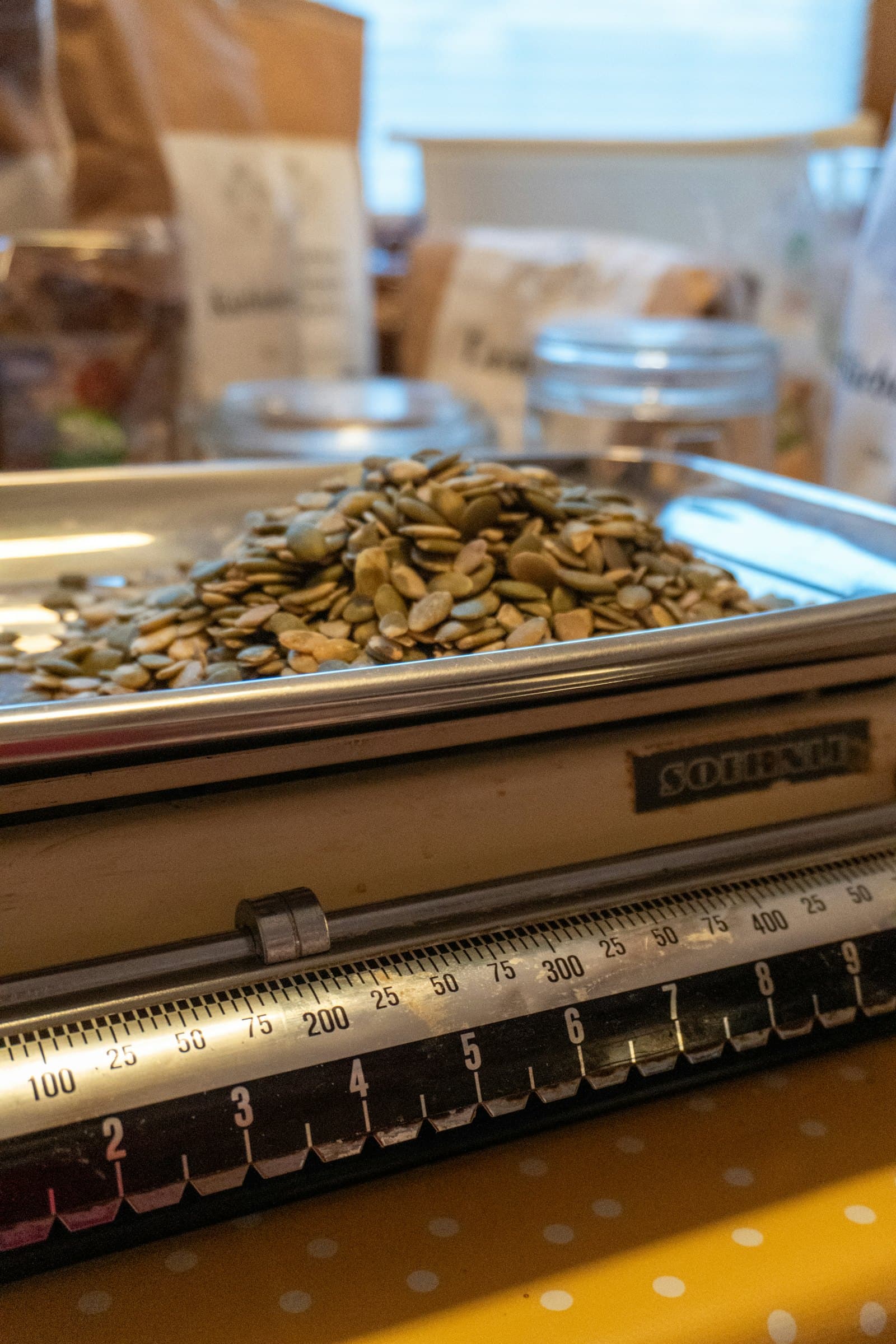
- Weigh what's easy to weigh. At home, a set of scales removes most of the guesswork for almost no effort. Weigh the oil especially — it's the highest-calorie thing you'll pour all day.
- Estimate the rest without ceremony. Meals out, someone else's cooking, the shared pot. Take your best guess and move on. A rough entry keeps the record continuous, which matters more than its accuracy.
- Log the same way every time. Same entries for your repeated meals, same habits for estimating. Consistency is doing the work here.
- Correct when you learn something. If you realise the portion was half what you logged, change it. A correction improves everything downstream — that's information arriving, not an admission of error.
- Let the trend arbitrate. Your weight over weeks is the only measurement in this system that isn't an estimate. When your logging and your trend disagree, the trend is right.
That last one is the whole answer, really. You have one honest instrument and a collection of approximations. Use the approximations to make decisions, and use the instrument to check whether the decisions worked.
Don't agonise over whether it was 380 or 450 — log it roughly and tell me if you find out you were off. I'm comparing what you eat to what your weight actually does, and that comparison is what fixes the numbers over time.
Why we'd rather tell you
There's an obvious commercial temptation here to present every figure as authoritative, because certainty is reassuring and reassurance sells.
We'd rather you knew. Partly because you'll find out anyway — usually at the worst moment, when the numbers say one thing and the scale says another, and the app has given you no way to make sense of the contradiction. And partly because a tracker that presents estimates as facts teaches you to distrust yourself when the two disagree, which is precisely backwards.
The honest version is more useful and, in the end, more reassuring: these are good estimates, they're consistent enough to steer by, and there's a real measurement checking them.
Let Sophia reconcile it
The number in the log is a claim. Your weight trend is the evidence. The useful work is in comparing the two — which is tedious, requires weeks of patience, and is exactly the sort of thing worth handing to a coach.
Sophia reconciles what you logged against what your weight actually did, and adjusts your targets from the outcome rather than the theory. If your logging runs low, she doesn't need you to discover that — the trend reveals it, and your targets move accordingly. Correct her whenever you know better, and the picture sharpens. You get to be approximately right, consistently, which is all this ever needed to be.